Logical Agents and Propositional Logic
Knowledge bases, the wumpus world, propositional logic, and inference.
Logical Agents
In which we design agents that can form representations of a complex world, use a process of inference to derive new representations about the world, and use these new representations to deduce what to do.
Knowledge-Based Agents
Knowledge Base (KB)
A knowledge base is a set of sentences. Each sentence is expressed in a knowledge representation language and represents some assertion about the world. A sentence taken as given without being derived from other sentences is called an axiom.
Inference
Inference is the process of deriving new sentences from old ones. The two fundamental operations on a knowledge base are:
TELL: add a new sentence to the knowledge base.
ASK: query what is known; the answer should follow from what has been told.
Knowledge Level vs. Implementation Level
At the knowledge level, we specify only what the agent knows and what its goals are, in order to fix its behavior. At the implementation level, we specify how the knowledge is actually represented and manipulated in code.
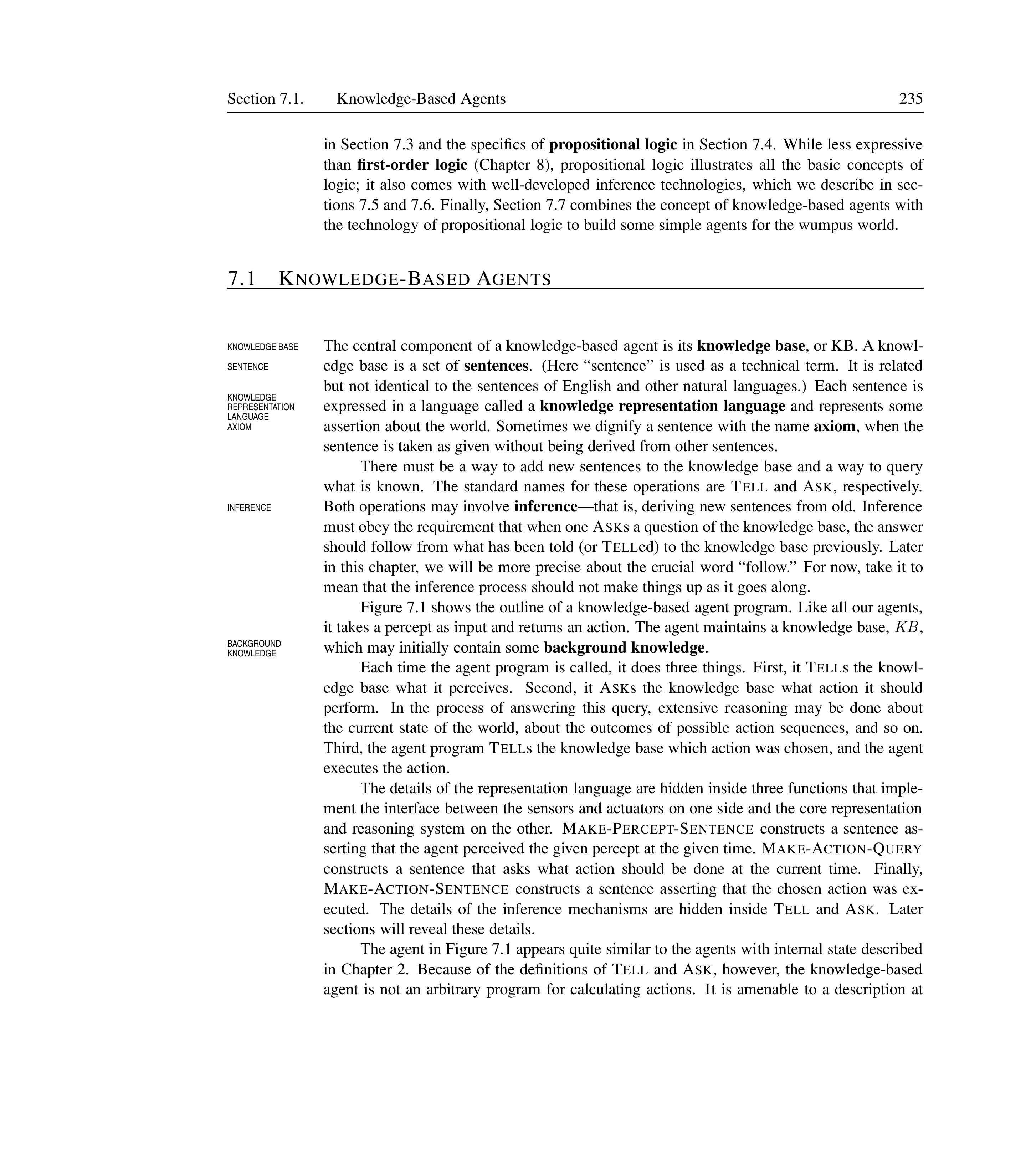
A knowledge-based agent program maintains a knowledge base (KB) and a counter $t$ indicating time. Given a percept, it constructs a percept sentence, tells the KB, asks for the best action, tells the KB the chosen action, and returns it.
KB-Agent Pseudocode
1
2
3
4
5
6
7
8
function KB-AGENT(percept) returns an action
  persistent: KB, a knowledge base
              t, a counter indicating time
  TELL(KB, MAKE-PERCEPT-SENTENCE(percept, t))
  action <- ASK(KB, MAKE-ACTION-QUERY(t))
  TELL(KB, MAKE-ACTION-SENTENCE(action, t))
  t <- t + 1
  return action
The declarative approach builds an agent by TELLing it what it needs to know, rather than writing procedural code. A successful agent often combines both declarative and procedural elements.

Declarative vs. Procedural
An automated taxi:
Declarative: TELL the agent “The Golden Gate Bridge connects San Francisco to Marin County.” The agent infers the route.
Procedural: Hard-code “If destination is Marin County and location is San Francisco, cross Golden Gate Bridge.”
The declarative approach is more flexible: the same knowledge works for any query, not just a specific one.
The Wumpus World
Wumpus World
The wumpus world is a cave consisting of rooms connected by passageways. A beast (the wumpus) eats anyone who enters its room. Some rooms contain bottomless pits. The agent can find a heap of gold. The agent has one arrow to shoot the wumpus.
| Agent | Wumpus Hunter |
|---|---|
| Performance | +1000 for climbing out with gold, $-1000$ for death (pit or wumpus), $-1$ per action, $-10$ for using arrow |
| Environment | $4 \times 4$ grid of rooms, agent starts at $[1,1]$ facing right, gold and wumpus random, pits with prob. 0.2 |
| Actuators | Forward, TurnLeft, TurnRight, Grab, Shoot, Climb |
| Sensors | Stench (wumpus adjacent), Breeze (pit adjacent), Glitter (gold), Bump (wall), Scream (wumpus killed) |
PEAS description of the wumpus world
The wumpus environment is discrete, static, single-agent, sequential, and partially observable.
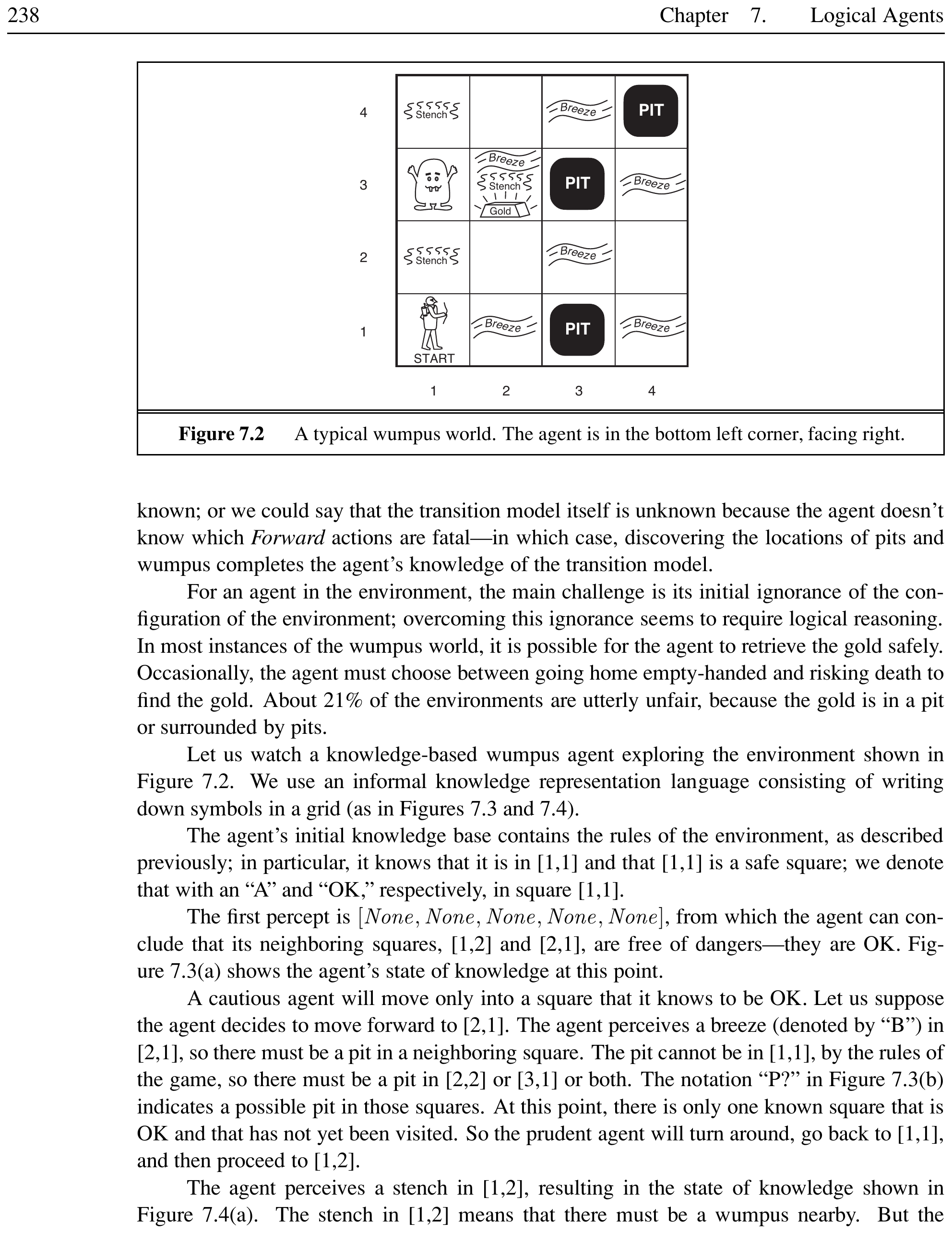
The agent explores the world, using logical reasoning to infer safe squares. For example, no breeze in $[1,1]$ means $[1,2]$ and $[2,1]$ are safe. A breeze in $[2,1]$ suggests a pit in $[2,2]$ or $[3,1]$. A stench in $[1,2]$ implies the wumpus is nearby.
Wumpus Agent Trajectory
Start at $[1,1]$: no percept $\Rightarrow$ $[1,2]$ and $[2,1]$ are safe.
Move to $[2,1]$: breeze $\Rightarrow$ pit in $[2,2]$ or $[3,1]$.
Return to $[1,1]$, move to $[1,2]$: stench $\Rightarrow$ wumpus in $[1,3]$ or $[2,2]$.
No breeze in $[1,2]$ $\Rightarrow$ no pit in $[2,2]$, so pit must be in $[3,1]$.
Conclude $[2,2]$ is safe, move there, then to $[2,3]$: glitter! Grab gold.
Logic
Syntax and Semantics
Syntax defines the allowable sentences in a representation language. Semantics defines the truth of each sentence with respect to each possible world. A sentence must be either true or false in each possible world.
Model and Satisfaction
A model $m$ is a mathematical abstraction that fixes the truth or falsehood of every relevant sentence. If a sentence $\alpha$ is true in model $m$, we say $m$ satisfies $\alpha$ or $m$ is a model of $\alpha$. The notation $M(\alpha)$ denotes the set of all models of $\alpha$.
Entailment
Entailment is the relation between sentences where one sentence follows logically from another: \(\alpha \models \beta \quad\text{iff}\quad M(\alpha) \subseteq M(\beta)\) That is, in every model in which $\alpha$ is true, $\beta$ is also true.
Inference, Soundness, Completeness
Logical inference is the process of deriving conclusions from premises. An inference algorithm is:
Sound (truth-preserving): it derives only entailed sentences.
Complete: it can derive any sentence that is entailed.

Grounding
Grounding is the connection between logical reasoning processes and the real environment. The agent’s sensors create this connection by generating percept sentences that are true in the real world.
Entailment in Wumpus World
KB = rules of wumpus world + percepts (no breeze in $[1,1]$, breeze in $[2,1]$). For $\alpha_1 = \neg P_{1,2}$ (no pit in $[1,2]$): \(KB \models \alpha_1 \quad\text{because in all 3 models where KB is true, } P_{1,2} \text{ is false.}\) For $\alpha_2 = \neg P_{2,2}$: \(KB \not\models \alpha_2 \quad\text{because } P_{2,2} \text{ is true in one model and false in another.}\)
Propositional Logic: A Very Simple Logic
Propositional Logic
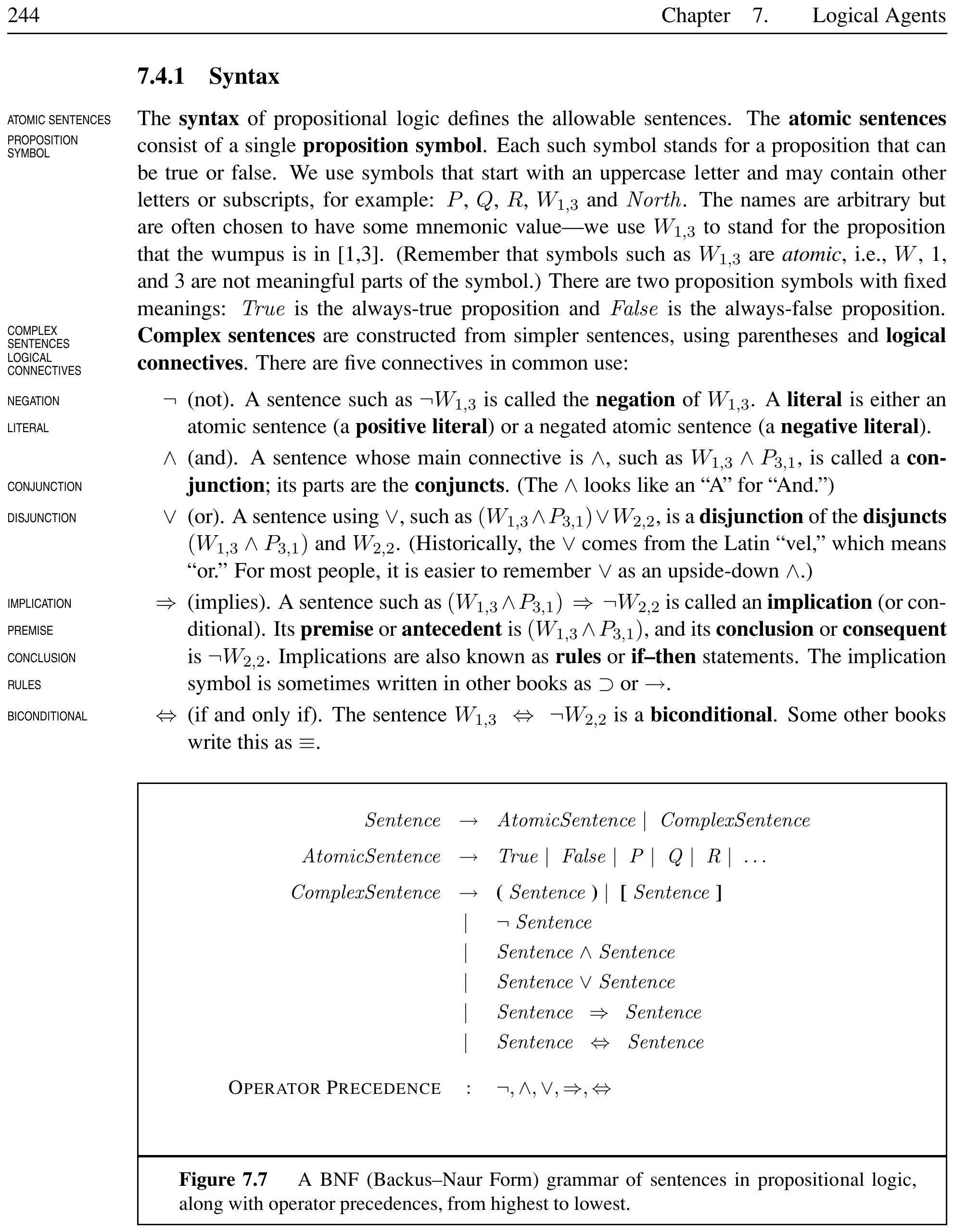
Propositional logic is a simple logic consisting of proposition symbols (atomic sentences) that can be true or false, combined with logical connectives.
Syntax of Propositional Logic
Atomic sentences: proposition symbols ($P, Q, R, W_{1,3}$) plus True and False. Complex sentences built with five connectives:
Negation $\neg$ (not): $\neg P$
Conjunction $\land$ (and): $P \land Q$
Disjunction $\lor$ (or): $P \lor Q$
Implication $\Rightarrow$ (implies): $P \Rightarrow Q$ (premise $\Rightarrow$ conclusion)
Biconditional $\Leftrightarrow$ (iff): $P \Leftrightarrow Q$
Operator precedence (highest to lowest): $\neg, \land, \lor, \Rightarrow, \Leftrightarrow$.
| $P$ | $Q$ | $\neg P$ | $P \land Q$ | $P \lor Q$ | $P \Rightarrow Q$ | $P \Leftrightarrow Q$ | |
|---|---|---|---|---|---|---|---|
| F | F | T | F | F | T | T | |
| F | T | T | F | T | T | F | |
| T | F | F | F | T | F | F | |
| T | T | F | T | T | T | T |
A model in propositional logic simply fixes the truth value (true or false) for every proposition symbol. For $n$ symbols, there are $2^n$ possible models. The truth of any complex sentence is computed recursively from its components.
Tautology, Contradiction, Contingency
Tautology (valid sentence): true in all models, e.g., $P \lor \neg P$.
Contradiction (unsatisfiable sentence): false in all models, e.g., $P \land \neg P$.
Contingency (satisfiable but not valid): true in some models, false in others, e.g., $P \land Q$.
Wumpus World Knowledge Base
Key proposition symbols:
$P_{x,y}$: pit in $[x,y]$
$W_{x,y}$: wumpus in $[x,y]$
$B_{x,y}$: breeze in $[x,y]$
$S_{x,y}$: stench in $[x,y]$
Sentences for the situation in Figure 7.3(b): \(\begin{aligned} R_1 &: \neg P_{1,1} \\ R_2 &: B_{1,1} \Leftrightarrow (P_{1,2} \lor P_{2,1}) \\ R_3 &: B_{2,1} \Leftrightarrow (P_{1,1} \lor P_{2,2} \lor P_{3,1}) \\ R_4 &: \neg B_{1,1} \\ R_5 &: B_{2,1} \end{aligned}\)
Model Checking Inference
Model checking enumerates all possible models to check that $\alpha$ is true in every model in which KB is true. The TT-ENTAILS? algorithm implements this directly: \(\text{TT-ENTAILS?}(KB, \alpha) \text{ checks if } M(KB) \subseteq M(\alpha)\) Time complexity: $O(2^n)$ for $n$ symbols. Space complexity: $O(n)$ (depth-first).
Propositional Theorem Proving
Logical Equivalence, Validity, Satisfiability
Logical equivalence: $\alpha \equiv \beta$ iff $\alpha \models \beta$ and $\beta \models \alpha$.
Validity: a sentence is valid (a tautology) if true in all models, e.g., $P \lor \neg P$.
Satisfiability: a sentence is satisfiable if true in some model.
The SAT problem: determine if a propositional sentence is satisfiable (NP-complete).
The deduction theorem: $\alpha \models \beta$ iff $(\alpha \Rightarrow \beta)$ is valid. Also: $\alpha \models \beta$ iff $(\alpha \land \neg\beta)$ is unsatisfiable (reductio ad absurdum or proof by contradiction).
| Name | Rule |
|---|---|
| Modus Ponens | $\displaystyle\frac{\alpha \Rightarrow \beta,\quad \alpha}{\beta}$ |
| Modus Tollens | $\displaystyle\frac{\alpha \Rightarrow \beta,\quad \neg\beta}{\neg\alpha}$ |
| And-Elimination | $\displaystyle\frac{\alpha \land \beta}{\alpha}$ |
| And-Introduction | $\displaystyle\frac{\alpha,\quad \beta}{\alpha \land \beta}$ |
| Or-Introduction | $\displaystyle\frac{\alpha}{\alpha \lor \beta}$ |
| Unit Resolution | $\displaystyle\frac{\ell_1 \lor \cdots \lor \ell_k,\quad m}{\ell_1 \lor \cdots \lor \ell_{i-1} \lor \ell_{i+1} \lor \cdots \lor \ell_k}$ |
| Full Resolution | $\displaystyle\frac{\ell_1 \lor \cdots \lor \ell_k,\quad m_1 \lor \cdots \lor m_n}{\ell_1 \lor \cdots \lor \ell_{i-1} \lor \ell_{i+1} \lor \cdots \lor \ell_k \lor m_1 \lor \cdots \lor m_{j-1} \lor m_{j+1} \lor \cdots \lor m_n}$ |
Standard Logical Equivalences
\[\begin{aligned} (\alpha \land \beta) &\equiv (\beta \land \alpha) \\ (\alpha \lor \beta) &\equiv (\beta \lor \alpha) \\ ((\alpha \land \beta) \land \gamma) &\equiv (\alpha \land (\beta \land \gamma)) \\ ((\alpha \lor \beta) \lor \gamma) &\equiv (\alpha \lor (\beta \lor \gamma)) \\ \neg(\neg\alpha) &\equiv \alpha \\ (\alpha \Rightarrow \beta) &\equiv (\neg\beta \Rightarrow \neg\alpha) \\ (\alpha \Rightarrow \beta) &\equiv (\neg\alpha \lor \beta) \\ (\alpha \Leftrightarrow \beta) &\equiv ((\alpha \Rightarrow \beta) \land (\beta \Rightarrow \alpha)) \\ \neg(\alpha \land \beta) &\equiv (\neg\alpha \lor \neg\beta) \\ \neg(\alpha \lor \beta) &\equiv (\neg\alpha \land \neg\beta) \\ (\alpha \land (\beta \lor \gamma)) &\equiv ((\alpha \land \beta) \lor (\alpha \land \gamma)) \\ (\alpha \lor (\beta \land \gamma)) &\equiv ((\alpha \lor \beta) \land (\alpha \lor \gamma)) \end{aligned}\]Resolution
Conjunctive Normal Form (CNF)
CNF is a conjunction of clauses, where each clause is a disjunction of literals. Every propositional sentence can be converted to CNF:
Eliminate $\Leftrightarrow$ (replace with $(\alpha \Rightarrow \beta) \land (\beta \Rightarrow \alpha)$)
Eliminate $\Rightarrow$ (replace $\alpha \Rightarrow \beta$ with $\neg\alpha \lor \beta$)
Move $\neg$ inwards (De Morgan, double negation)
Distribute $\lor$ over $\land$
Factoring (also called pure literal elimination) removes duplicate literals within a clause and removes clauses containing complementary literals.
Wumpus Resolution Proof
Prove $\neg P_{1,2}$ from KB: \(\begin{aligned} R_2 &: B_{1,1} \Leftrightarrow (P_{1,2} \lor P_{2,1}) \\ R_4 &: \neg B_{1,1} \\ R_6 &: (B_{1,1} \Rightarrow (P_{1,2} \lor P_{2,1})) \land ((P_{1,2} \lor P_{2,1}) \Rightarrow B_{1,1}) \\ R_7 &: (P_{1,2} \lor P_{2,1}) \Rightarrow B_{1,1} \\ R_8 &: \neg B_{1,1} \Rightarrow \neg(P_{1,2} \lor P_{2,1}) \\ R_9 &: \neg(P_{1,2} \lor P_{2,1}) \\ R_{10} &: \neg P_{1,2} \land \neg P_{2,1} \end{aligned}\) Resolution is complete for propositional logic: if a set of clauses is unsatisfiable, repeated resolution will derive the empty clause.
Key Properties
Resolution is sound: the resolvent follows logically from the parent clauses.
Resolution is complete for propositional logic: if $KB \land \neg\alpha$ is unsatisfiable, resolution will derive the empty clause.
PL-RESOLUTION always terminates because only finitely many distinct clauses can be formed from the $k$ proposition symbols.
Resolution is refutation-complete: it proves $\alpha$ from $KB$ by deriving a contradiction from $KB \land \neg\alpha$.
Horn Clauses and Definite Clauses
Horn and Definite Clauses
Definite clause: a disjunction of literals with exactly one positive literal. Equivalent to $(P_1 \land \cdots \land P_k) \Rightarrow Q$.
Horn clause: a disjunction with at most one positive literal. Includes definite clauses and goal clauses (no positive literals).
Fact: a definite clause with no negative literals (e.g., $L_{1,1}$).
Horn clauses are closed under resolution. Entailment with Horn clauses is decidable in $O(n)$ time.
Forward Chaining
Forward chaining is data-driven: start from known facts, apply Modus Ponens to derive new facts until the query is proved or no more inferences are possible.
Rules: $A \land B \Rightarrow L$, $A \land P \Rightarrow L$, $B \land L \Rightarrow M$, $L \land M \Rightarrow P$, $P \Rightarrow Q$. Facts: $A$, $B$.
Start with agenda: $A, B$.
Process $A$: count[$A \land B \Rightarrow L$] decrements from 2 to 1.
Process $B$: count[$A \land B \Rightarrow L$] becomes 0 $\Rightarrow$ add $L$.
Process $L$: count[$B \land L \Rightarrow M$] becomes 0 $\Rightarrow$ add $M$, count[$L \land M \Rightarrow P$] becomes 1.
Process $M$: count[$L \land M \Rightarrow P$] becomes 0 $\Rightarrow$ add $P$.
Process $P$: count[$P \Rightarrow Q$] becomes 0 $\Rightarrow$ add $Q$. Query $Q$ proved!
Backward Chaining
Backward chaining is goal-directed: start from the query and work backward through implications until known facts are reached. For query $Q$:
Find $P \Rightarrow Q$. Need to prove $P$.
Find $L \land M \Rightarrow P$. Need to prove $L$ and $M$.
Find $A \land B \Rightarrow L$: $A$ and $B$ are known facts $\Rightarrow$ $L$ proved.
Find $B \land L \Rightarrow M$: $B$ and $L$ are known $\Rightarrow$ $M$ proved.
All premises satisfied $\Rightarrow$ $Q$ proved.
Backward chaining touches only relevant facts, making it more efficient for specific queries.
Key Properties
Forward chaining is sound and complete for Horn clauses.
Backward chaining is sound and complete for Horn clauses.
Both run in linear time $O(n)$.
Monotonicity: if $KB \models \alpha$, then $KB \land \beta \models \alpha$ for any $\beta$.
Effective Propositional Model Checking
SAT Problem
The SAT problem is the problem of determining whether a propositional sentence is satisfiable. Testing entailment $KB \models \alpha$ reduces to testing unsatisfiability of $KB \land \neg\alpha$.
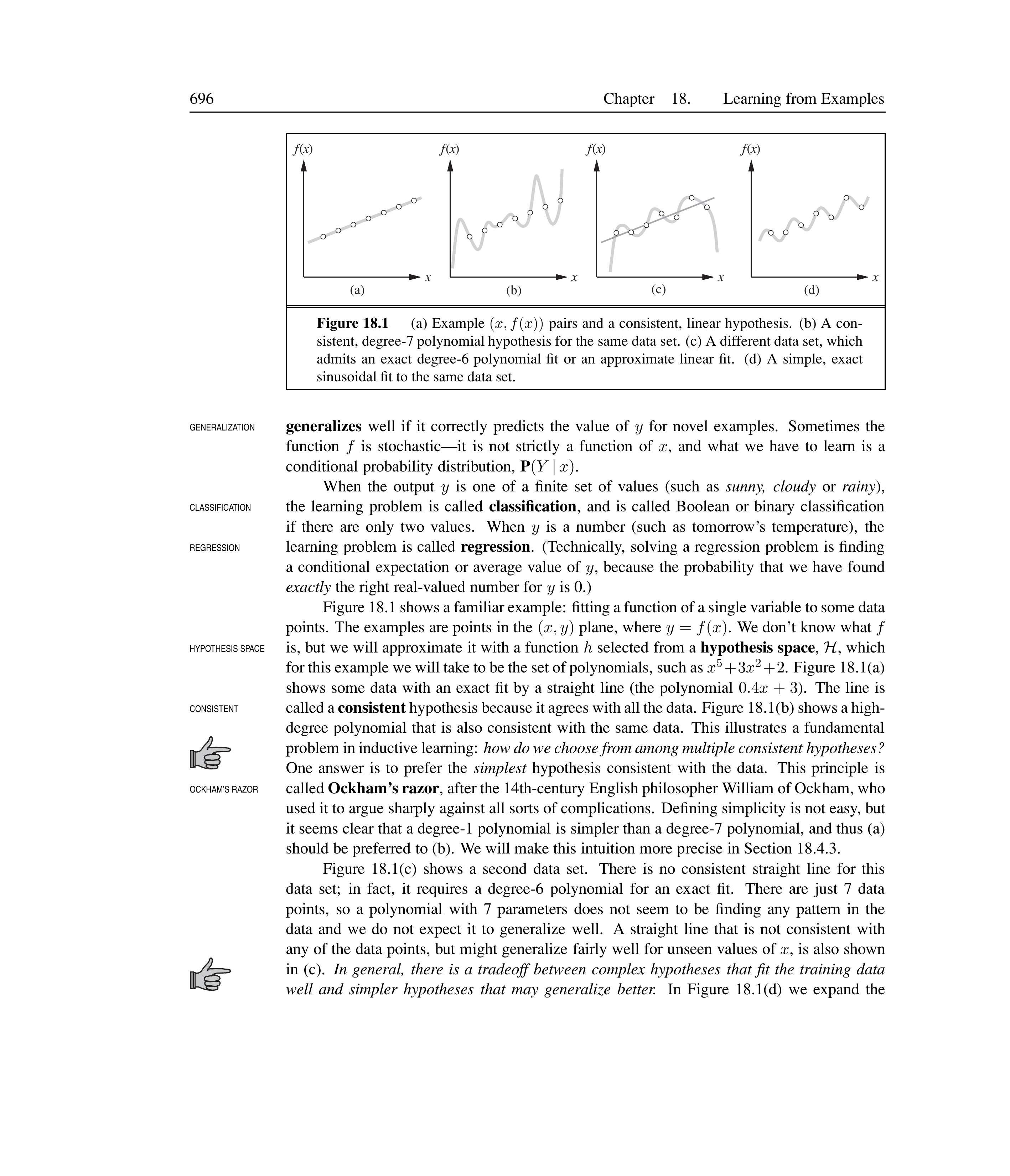
DPLL
DPLL Algorithm
The DPLL (Davis–Putnam–Logemann–Loveland) algorithm is a complete, backtracking-based SAT solver for CNF sentences. It improves over naive model checking with three key techniques:
Early termination: detect if sentence is true (all clauses satisfied) or false (any clause falsified) with a partial model.
Pure symbol heuristic: a symbol appearing with only one sign in all remaining clauses can be assigned to make its literals true.
Unit clause heuristic: a clause with all literals false except one forces that literal to true. Cascading assignments are called unit propagation.
DPLL Trace
Consider clauses: $(A \lor B) \land (A \lor \neg C) \land (\neg B \lor \neg C)$.
Pure symbol: $C$ appears only as negative literal $\neg C$ $\Rightarrow$ assign $C =$ false.
After $C =$ false: clauses $\Rightarrow (A \lor B) \land (A \lor \text{true}) \land (\neg B \lor \text{true})$.
Empty clause? No. $(A \lor \text{true})$ and $(\neg B \lor \text{true})$ are satisfied.
Remaining: $(A \lor B)$. Unit clause? No. Pure symbol? $A$ and $B$ both appear positive.
Split on $A =$ true $\Rightarrow$ all clauses satisfied. Model found!
Key Properties
DPLL is complete: it will eventually find a model if one exists, or prove unsatisfiability.
Early termination, pure symbol heuristic, and unit propagation prune large portions of the search space.
Modern SAT solvers add conflict-driven clause learning (CDCL), component analysis, and random restarts.
DPLL with these enhancements can handle problems with tens of millions of variables.
WalkSAT
WalkSAT
WalkSAT is a local search algorithm for SAT. It starts with a random assignment and repeatedly flips a symbol in an unsatisfied clause, choosing randomly between:
Min-conflicts: flip the symbol that maximizes the number of satisfied clauses.
Random walk: flip a random symbol from the clause.
WalkSAT is sound (finds model if one exists with enough time) but not complete (cannot prove unsatisfiability).
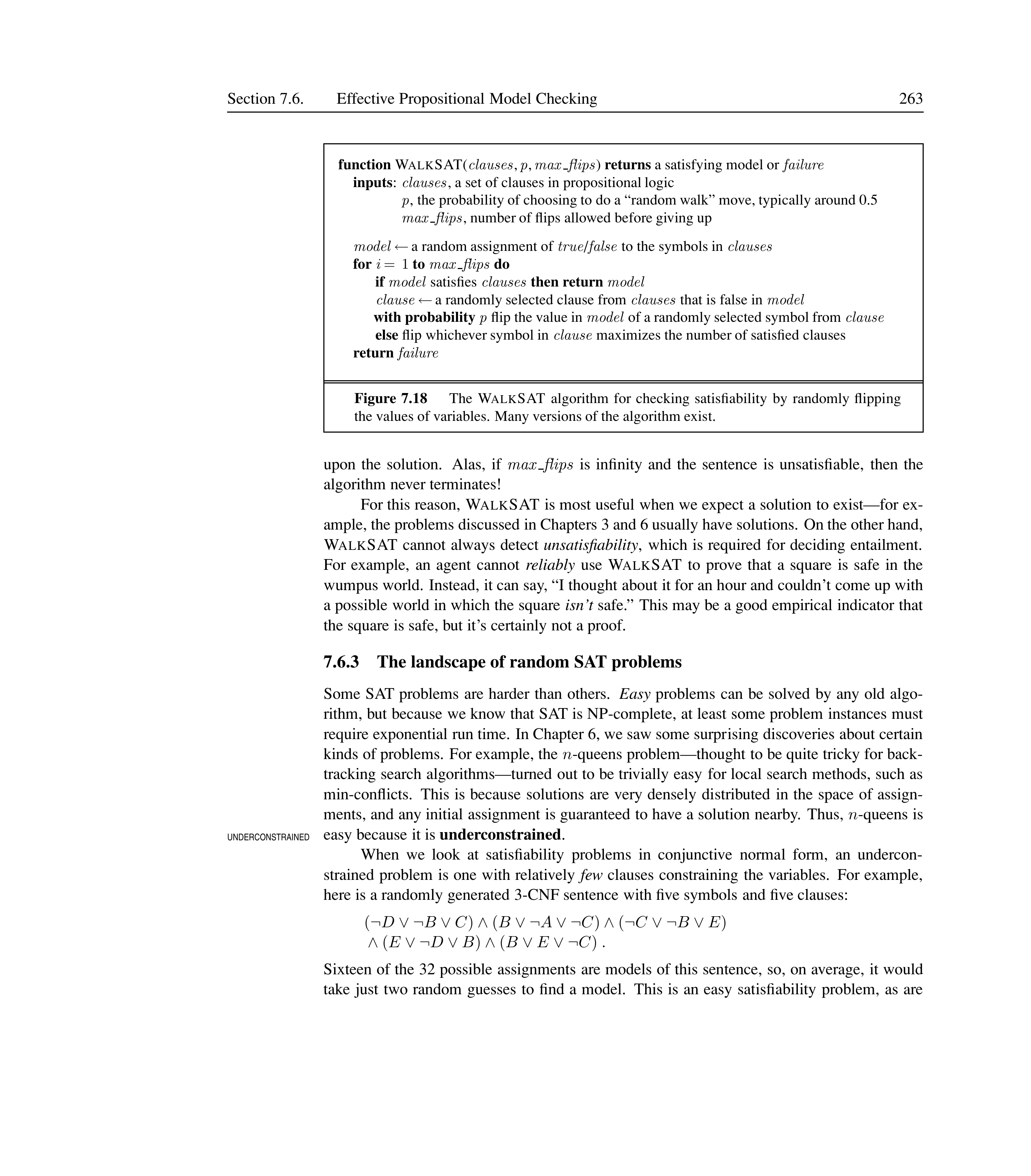
WalkSAT Trace
Clauses: $(A \lor B) \land (\neg A \lor \neg B) \land (A \lor \neg B)$. Random assignment: $A=T, B=T$.
Check: $(T \lor T)=T$, $(\neg T \lor \neg T)=(\neg T)=F$, $(T \lor \neg T)=T$. Clause 2 is false.
Pick clause 2: $(\neg A \lor \neg B)$. Symbols: $A$ (negative), $B$ (negative).
With prob $p=0.5$: flip random symbol. Or compute scores: flip $A$ $\Rightarrow$ all satisfied (score 3), flip $B$ $\Rightarrow$ all satisfied (score 3). Either flip works.
New assignment: $A=F, B=T$ (or $A=T, B=F$). All clauses satisfied!
Key Properties
WalkSAT is sound (if it returns a model, the sentence is satisfiable) but not complete (failure does not imply unsatisfiability).
Most useful when a solution is expected to exist (e.g., CSPs, planning).
Performance depends on the probability parameter $p$ (typically $\approx 0.5$) and the clause/symbol ratio.
Hardest random 3-SAT instances cluster near the satisfiability threshold ($m/n \approx 4.26$).
Satisfiability Threshold Conjecture
For random $k$-CNF sentences with $n$ symbols and $m$ clauses, there exists a threshold ratio $r_k = m/n$ such that as $n \to \infty$:
Below $r_k$: satisfiable with probability 1.
Above $r_k$: unsatisfiable with probability 1.
For $k=3$, the threshold is approximately $4.26$. The hardest problems cluster near this threshold.
Agents Based on Propositional Logic
Fluent and Atemporal Variable
A fluent is an aspect of the world that changes over time, indexed by time step (e.g., $L^t_{x,y}$, $HaveArrow^t$). An atemporal variable is a permanent aspect, not indexed by time (e.g., $P_{x,y}$, $W_{x,y}$).
Frame Problem
The frame problem is the challenge of specifying what remains unchanged after an action. Solutions include:
Effect axioms: explicit axioms for each fluent that changes under each action ($O(mn)$ axioms).
Frame axioms: explicit axioms for each fluent that stays unchanged under each action ($O(mn)$ axioms).
Successor-state axioms: for each fluent $F$, define $F^{t+1}$ in terms of $F^t$ and actions at time $t$ ($O(mk)$ axioms):
\(F^{t+1} \Leftrightarrow ActionCausesF^t \lor (F^t \land \neg ActionCausesNotF^t)\) The qualification problem is the challenge of specifying all preconditions for an action to have its intended effect.
Successor-State Axiom for HaveArrow
\(HaveArrow^{t+1} \Leftrightarrow (HaveArrow^t \land \neg Shoot^t)\) The arrow is present at $t+1$ iff it was present at $t$ and not used.
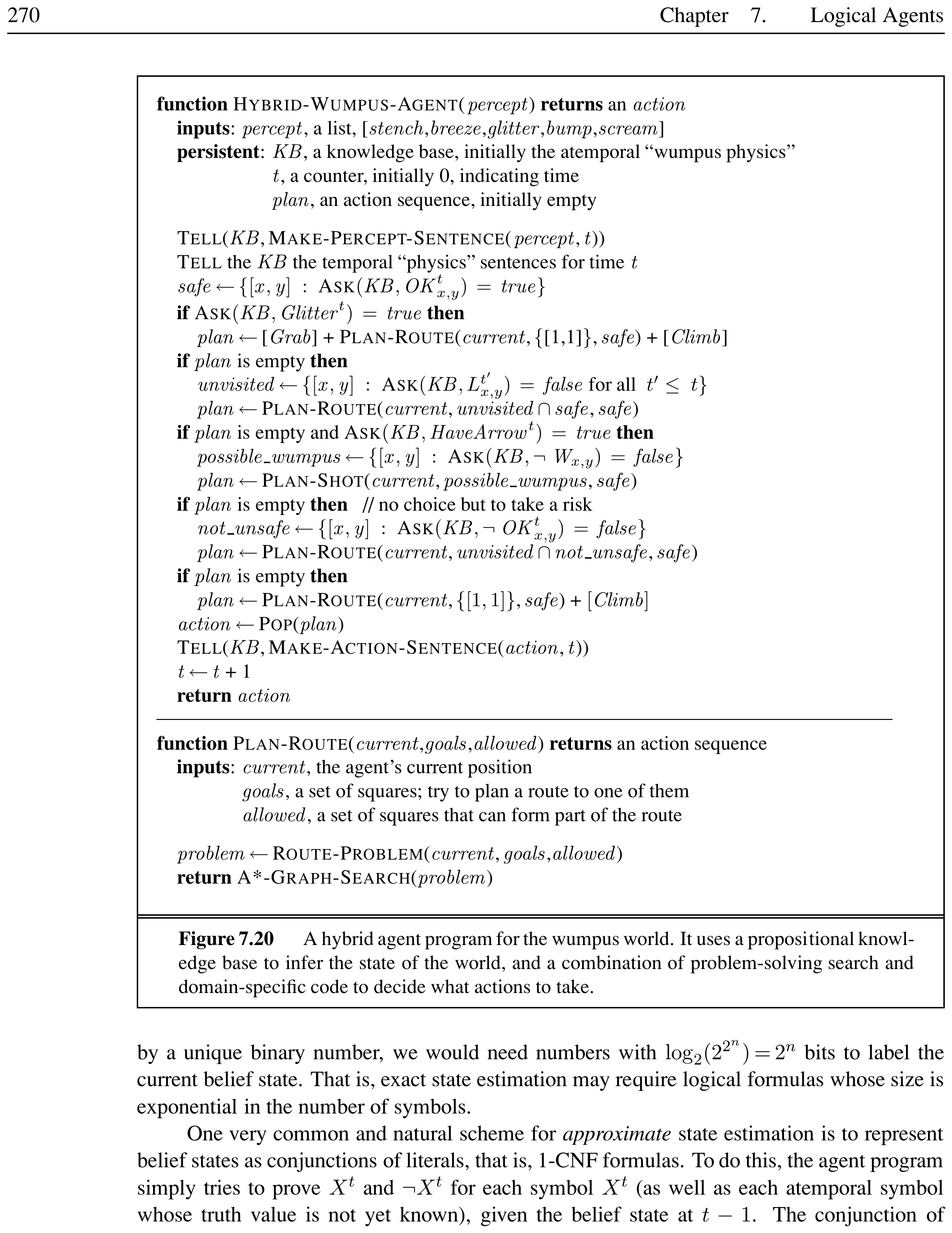
Hybrid Wumpus Agent Logic
1
2
3
4
5
6
7
8
9
10
11
12
13
14
15
16
17
18
19
20
21
22
function HYBRID-WUMPUS-AGENT(percept) returns an action
  persistent: KB, t, plan
  TELL(KB, MAKE-PERCEPT-SENTENCE(percept, t))
  TELL(KB, temporal "physics" sentences for time t)
  safe <- {[x,y]: ASK(KB, OK^t_x,y) = true}
  if ASK(KB, Glitter^t) = true then
    plan <- [Grab] + PLAN-ROUTE(current, {[1,1]}, safe) + [Climb]
  if plan is empty then
    unvisited <- {[x,y]: ASK(KB, L^t_x,y) = false for all t' <= t}
    plan <- PLAN-ROUTE(current, unvisited & safe, safe)
  if plan is empty and ASK(KB, HaveArrow^t) = true then
    possible-wumpus <- {[x,y]: ASK(KB, not W_x,y) = false}
    plan <- PLAN-SHOT(current, possible-wumpus, safe)
  if plan is empty then
    not-unsafe <- {[x,y]: ASK(KB, not OK^t_x,y) = false}
    plan <- PLAN-ROUTE(current, unvisited & not-unsafe, safe)
  if plan is empty then
    plan <- PLAN-ROUTE(current, {[1,1]}, safe) + [Climb]
  action <- POP(plan)
  TELL(KB, MAKE-ACTION-SENTENCE(action, t))
  t <- t + 1
  return action
The hybrid agent maintains a 1-CNF belief state (conjunction of literals) as a conservative approximation of the true belief state. This approximation is guaranteed to include all states consistent with the percept history, but may lose disjunctive information.
Key Properties
The hybrid agent is sound: all inferences from the KB are logically guaranteed.
State estimation via 1-CNF is an approximation guaranteed to include all true states but may lose disjunctive information.
Successor-state axioms solve the representational frame problem with $O(mk)$ axioms instead of $O(mn)$.
Precondition axioms and action exclusion axioms prevent spurious SATPlan solutions with illegal or simultaneous actions.
Three PL Agent Types
Reflex agent: condition–action rules directly map percepts to actions. No internal state. E.g., “If breeze, turn away.”
Hybrid agent: logical KB for state estimation + A* search for planning. E.g., the HYBRID-WUMPUS-AGENT (Figure [fig:hybrid-agent]).
Planning agent (SATPlan): formulates the entire planning problem as a SAT instance and uses a SAT solver to find a plan. Finds shortest plan by iterating $t = 0, 1, \dots, T_{max}$.
SATPlan
SATPlan
SATPlan formulates planning as SAT: construct a sentence containing initial state, successor-state axioms, precondition axioms, and action exclusion axioms for time steps $0$ to $t$, and ask a SAT solver to find a model. The actions assigned true in the model form the plan. SATPlan finds the shortest plan by trying $t = 0, 1, 2, \dots$ up to $T_{max}$.
Reasoning in Propositional Logic
Deductive Reasoning
Deductive reasoning (deduction) moves from general premises to specific conclusions. If the premises are true, the conclusion is guaranteed to be true. In propositional logic, this corresponds to entailment: $KB \models \alpha$. \(\text{General} \rightarrow \text{Specific} \quad\text{e.g., All humans are mortal; Socrates is human} \Rightarrow \text{Socrates is mortal}\)
Inductive Reasoning
Inductive reasoning (induction) moves from specific observations to general conclusions. The conclusion is probable but not guaranteed. \(\text{Specific} \rightarrow \text{General} \quad\text{e.g., Observed 100 swans, all white} \Rightarrow \text{All swans are white}\)
Abductive Reasoning
Abductive reasoning (abduction) infers the best explanation for observed facts. Given a rule $A \Rightarrow B$ and observed $B$, infer $A$ as a possible explanation. \(\text{Observed} \rightarrow \text{Best explanation} \quad\text{e.g., Grass is wet} \Rightarrow \text{It rained (best explanation)}\) Abduction is not logically sound ($B$ does not entail $A$), but is essential for diagnosis and common-sense reasoning.
Knights and Knaves Puzzle
On an island, knights always tell the truth and knaves always lie. You meet two people: A and B. A says: “B is a knight.” B says: “We are different types.”
Solution using propositional logic: Let $A$ = “A is a knight” and $B$ = “B is a knight”.
If A is a knight ($A$ true): A’s statement ($B$) is true $\Rightarrow$ $B$ true.
If B is a knight ($B$ true): B’s statement ($A \oplus B$) is true $\Rightarrow$ $A \oplus B$ is true. But $A$ and $B$ are both true $\Rightarrow$ contradiction!
Therefore A cannot be a knight; A must be a knave ($A$ false).
A said $B$, which is false $\Rightarrow$ $B$ is false (B is a knave).
Check: B said $A \oplus B$. With $A$ false, $B$ false: $A \oplus B$ is false, which is consistent with B being a knave.
Conclusion: Both are knaves.
Exam Question
What are the drawbacks of propositional logic?
Solution
Limited expressiveness: cannot represent objects, relations, or quantifiers. Each fact requires a separate symbol (e.g., $P_{1,1}, P_{1,2}, \dots$ for each square).
No structure: proposition symbols are atomic with no internal structure.
Scalability: requires $O(n \times m)$ axioms for $n$ time steps and $m$ squares; cannot express “for all squares” or “for all times” concisely.
Frame problem: must explicitly specify what stays unchanged.
These limitations motivate first-order logic (Chapter 8), which can describe a wumpus world of any size in about ten sentences.
Exam Question
What are the components of a knowledge base system? Explain with a suitable diagram.
Solution
A knowledge base system consists of:
Knowledge Base (KB): stores sentences (axioms and derived facts).
Inference Engine: applies inference rules to derive new sentences.
TELL interface: adds new sentences to the KB.
ASK interface: queries the KB for entailed sentences.
Knowledge Acquisition: mechanism to add domain knowledge.
See Figure [fig:kb-agent] for the architecture diagram.
Summary
Key points from this chapter:
Knowledge-based agents store sentences in a KB and use inference to derive new sentences and decide actions.
The wumpus world is a benchmark environment for logical agents with PEAS: performance (gold reward), discrete $4\times4$ grid, five sensors, six actuators.
Logic consists of syntax (well-formed sentences) and semantics (truth in models). Entailment ($\models$) is truth in all models of the KB.
Propositional logic provides atomic sentences and truth-functional connectives ($\neg, \land, \lor, \Rightarrow, \Leftrightarrow$).
Theorem proving uses inference rules (Modus Ponens, resolution) to construct proofs. Resolution in CNF is complete for propositional logic.
Horn clauses enable efficient $O(n)$ forward and backward chaining.
Model checking enumerates models (TT-ENTAILS?), or uses backtracking (DPLL) or local search (WalkSAT).
Agents based on PL deal with fluents, the frame problem (solved by successor-state axioms), and the qualification problem.
Hybrid agents combine logical state estimation with search-based planning.
Propositional logic is limited in expressiveness, motivating first-order logic (Chapter 8).