Intelligent Agents
Agents, environments, rationality, PEAS, and the five agent architectures.
Intelligent Agents
In which we discuss the nature of agents, perfect or otherwise, the diversity of environments, and the resulting menagerie of agent types.
Agents and Environments
Agent
An agent is anything that can be viewed as perceiving its environment through sensors and acting upon that environment through actuators.
Percept and Percept Sequence
A percept is the agent’s perceptual input at any given instant. An agent’s percept sequence is the complete history of everything the agent has ever perceived.
Agent Function and Agent Program
The agent function maps any given percept sequence to an action. The agent program is a concrete implementation of the agent function, running on some physical architecture.
where $\mathcal{P}$ is the set of possible percepts and $\mathcal{A}$ is the set of possible actions.
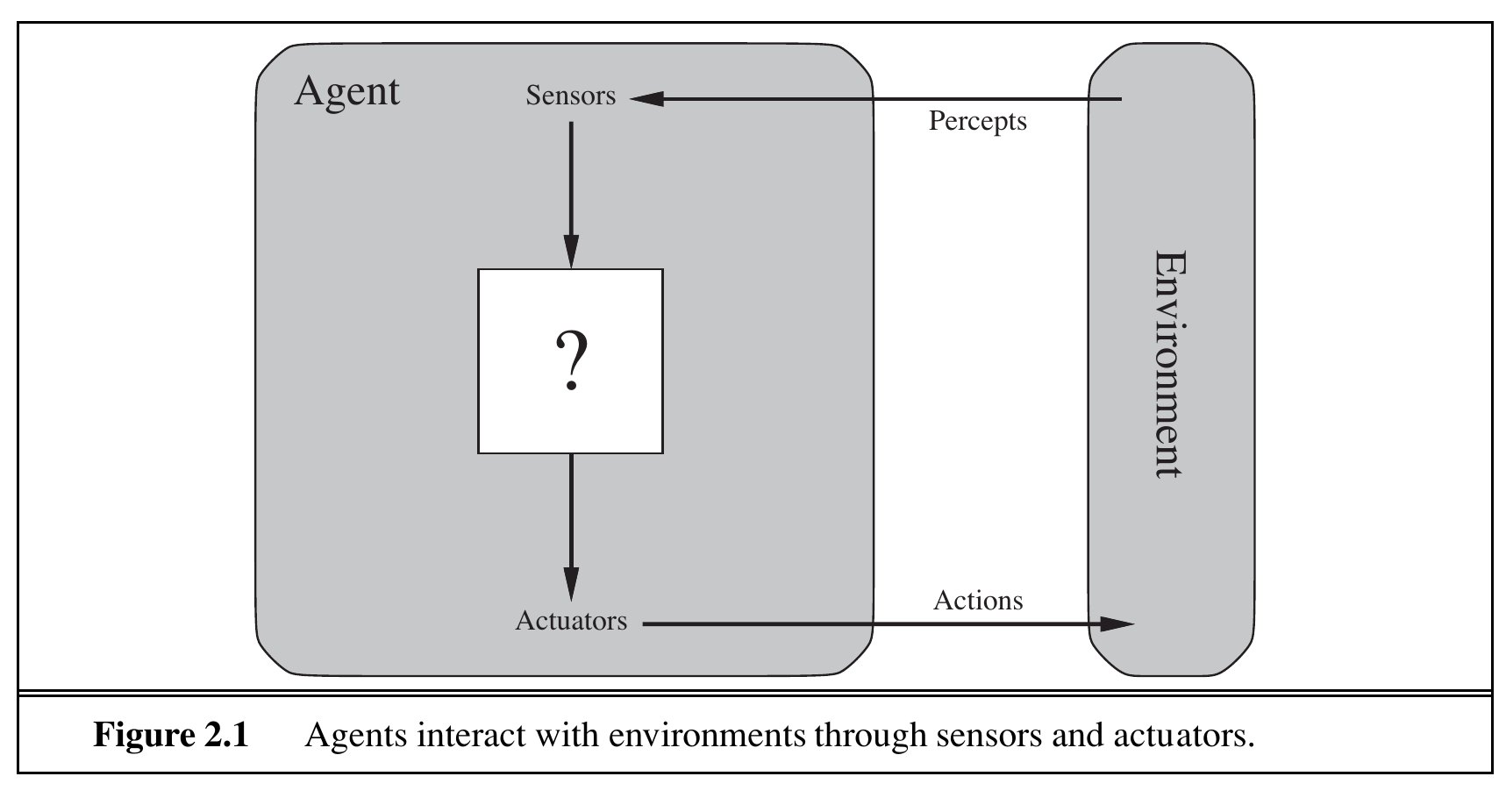
An agent’s choice of action at any instant can depend on the entire percept sequence observed to date, but not on anything it hasn’t perceived. The agent function is an abstract mathematical description; the agent program is a concrete implementation running within some physical system.
Types of Agents
Human agent: sensors include eyes, ears, skin; actuators include hands, legs, vocal tract.
Robotic agent: sensors include cameras, infrared range finders; actuators include motors, grippers.
Software agent (softbot): sensors include keystrokes, file contents, network packets; actuators include displays, file writes, network messages.
Vacuum-Cleaner World
Consider a world with two locations: squares A and B. The vacuum agent perceives which square it is in and whether there is dirt. Actions are: move left, move right, suck, or do nothing.
A simple rule: if the current square is dirty, suck; otherwise, move to the other square.
| Percept sequence | Action |
|---|---|
| [A, Clean] | Right |
| [A, Dirty] | Suck |
| [B, Clean] | Left |
| [B, Dirty] | Suck |
| [A, Clean], [A, Clean] | Right |
| [A, Clean], [A, Dirty] | Suck |
| $\vdots$ | $\vdots$ |
Partial tabulation of a simple vacuum-cleaner agent function
The notion of an agent is a tool for analyzing systems, not an absolute characterization. A hand-held calculator could be viewed as an agent, but such an analysis would hardly aid understanding. AI operates at the most interesting end of the spectrum, where artifacts have significant computational resources and the task environment requires nontrivial decision making.
Good Behavior: The Concept of Rationality
Rational Agent
A rational agent is one that does the right thing. For each possible percept sequence, a rational agent should select an action that is expected to maximize its performance measure, given the evidence provided by the percept sequence and whatever built-in knowledge the agent has.
where $P(s)$ is the performance measure evaluating environment state $s$, and $\mathbb{E}$ denotes expected value.
Performance Measure
A performance measure evaluates any given sequence of environment states. It captures the designer’s notion of what constitutes success. The performance measure must be defined externally, not by the agent’s own opinion of its performance.
Good performance measures reward what we actually want, not how we think the agent should behave. For example, a vacuum agent rewarded for dirt cleaned up might dump and re-clean dirt repeatedly. A better measure rewards clean floors over time.
Rationality Depends on Four Things
What is rational at any given time depends on:
The performance measure defining success.
The agent’s prior knowledge of the environment.
The actions the agent can perform.
The agent’s percept sequence to date.
Rational Vacuum Agent
Given:
Performance measure: 1 point per clean square per time step (1000 steps).
Known geography: two squares A and B; cleaning stays; actions move or suck.
Actions: Left, Right, Suck.
Percepts: location and dirt status.
The agent that sucks when dirty and moves otherwise is rational under these conditions. It would be irrational if movements carried a penalty, if dirt could reappear, or if geography were unknown.
Omniscience, Learning, and Autonomy
Omniscience vs. Information Gathering
An omniscient agent knows the actual outcome of its actions. Omniscience is impossible in reality. Rationality maximizes expected performance, not actual performance. Information gathering – performing actions to modify future percepts – is an important part of rationality.
Exploration and Learning
Exploration is information gathering in initially unknown environments. Learning allows an agent to modify its behavior based on experience, compensating for partial or incorrect prior knowledge.
Autonomy
An agent is autonomous to the extent that its behavior depends on its own experience rather than on the designer’s prior knowledge. A rational agent should learn what it can to compensate for incomplete prior knowledge.
Rationality vs. Perfection
Crossing a street when no traffic is visible is rational – the expected outcome is safe passage. If a cargo door falls from an airliner and strikes you mid-crossing, the outcome was bad, but the decision was still rational. Rationality is not the same as perfection.
Learning in the Sphex Wasp
The sphex wasp follows a fixed plan: dig burrow, sting caterpillar, drag it in, check burrow, lay eggs. If a researcher moves the caterpillar during the check phase, the wasp repeats the drag step endlessly. It cannot learn that its plan is failing. A rational, autonomous agent would recognize the failure and adapt.
The Nature of Environments
Task Environment
A task environment is the “problem” to which a rational agent is the “solution.” It is specified by the PEAS description: Performance measure, Environment, Actuators, Sensors.
Specifying the Task Environment with PEAS
The first step in designing an agent is to fully specify its task environment using PEAS.
| Agent | Taxi driver | |
|---|---|---|
| Performance | Safe, fast, legal, comfortable trip; maximize profits | |
| Environment | Roads, other traffic, pedestrians, customers | |
| Actuators | Steering, accelerator, brake, signal, horn, display | |
| Sensors | Cameras, sonar, speedometer, GPS, odometer, accelerometer, engine sensors, keyboard |
PEAS description for an automated taxi driver
| Agent Type | Performance | Environment | Actuators | Sensors |
|---|---|---|---|---|
| Medical diagnosis | Healthy patient, reduced costs | Patient, hospital, staff | Display of questions, tests, diagnoses | Keyboard entry of symptoms |
| Satellite image analysis | Correct categorization | Downlink from satellite | Display of categorization | Color pixel arrays |
| Part-picking robot | Percentage in correct bins | Conveyor belt with parts | Jointed arm and hand | Camera, joint angle sensors |
| Refinery controller | Purity, yield, safety | Refinery, operators | Valves, pumps, heaters, displays | Temperature, pressure, chemical sensors |
| Interactive English tutor | Student’s score on test | Set of students, testing agency | Display of exercises, suggestions | Keyboard entry |
PEAS descriptions for various agent types
Properties of Task Environments
Task environments can be categorized along seven key dimensions. These dimensions determine the appropriate agent design and the applicability of different AI techniques.
Environment Classifications
The seven dichotomies categorize environments along these dimensions:
Fully observable vs. Partially observable vs. Unobservable
Single-agent vs. Multiagent (competitive vs. cooperative)
Deterministic vs. Stochastic vs. Uncertain vs. Nondeterministic
Episodic vs. Sequential
Static vs. Dynamic vs. Semidynamic
Discrete vs. Continuous
Known vs. Unknown
Figure: The seven dimensions of task environment classification (part 1/2): observability, agents, determinism, and task structure.
Figure: The seven dimensions of task environment classification (part 2/2): dynamism, state/time, and prior knowledge.
Fully Observable vs. Partially Observable
If an agent’s sensors give it access to the complete state of the environment at each point in time, the environment is fully observable. Otherwise, it is partially observable. An environment with no sensors at all is unobservable. Fully observable environments are convenient because the agent need not maintain internal state.
Observability Examples
Fully observable: Chess (the board state is fully visible).
Partially observable: Poker (opponents’ cards are hidden); Taxi driving (other drivers’ intentions are unknown).
Unobservable: A blind agent with no sensors at all.
Single Agent vs. Multiagent
A single-agent environment contains only one agent making decisions. A multiagent environment contains other agents whose behavior affects performance. Multiagent environments can be competitive (e.g., chess) or cooperative (e.g., taxi driving where avoiding collisions benefits all).
Agent Count Examples
Single agent: Crossword puzzle solver.
Competitive multiagent: Chess (one player’s win is the other’s loss).
Cooperative multiagent: Traffic (all drivers benefit from avoiding collisions).
Deterministic vs. Stochastic
If the next state of the environment is completely determined by the current state and the agent’s action, the environment is deterministic. Otherwise, it is stochastic. An environment is uncertain if it is not fully observable or not deterministic. Nondeterministic environments describe possible outcomes without probabilities.
Determinism Examples
Deterministic: Chess (move outcomes are fixed by the rules).
Stochastic: Taxi driving (traffic, weather, tire blowouts are unpredictable).
Nondeterministic: An action with possible outcomes ${a, b, c}$ but no probabilities assigned.
Episodic vs. Sequential
In an episodic environment, each episode is independent; the next episode does not depend on previous actions. In a sequential environment, current decisions affect all future decisions.
Episodicity Examples
Episodic: Defective part detection on an assembly line.
Sequential: Chess (each move affects all subsequent moves); Taxi driving (a wrong turn can cause lasting delay).
Static vs. Dynamic
If the environment can change while the agent is deliberating, it is dynamic. Otherwise, it is static. In a semidynamic environment, the environment itself does not change, but the agent’s performance score does.
Dynamics Examples
Static: Crossword puzzle.
Dynamic: Taxi driving (cars move while you decide).
Semidynamic: Chess with a clock (board is static but time ticks).
Discrete vs. Continuous
The discrete/continuous distinction applies to states, time, percepts, and actions. Discrete environments have a finite number of distinct states; continuous environments have smoothly varying values.
Discreteness Examples
Discrete: Chess (finite board positions); Backgammon (21 dice outcomes).
Continuous: Taxi driving (speed, location, steering angle vary continuously).
Known vs. Unknown
In a known environment, the outcomes of all actions are given. In an unknown environment, the agent must learn how the world works. This distinction refers to the agent’s state of knowledge, not the environment itself.
Known-ness Examples
Known: Chess (rules are known).
Unknown: A new video game (must learn what buttons do by trying).
A known environment can be partially observable (solitaire – I know the rules but not the hidden cards). An unknown environment can be fully observable (new video game – full screen display but unknown button effects).
| Task Environment | Observable | Agents | Deterministic | Episodic | Static | Discrete |
|---|---|---|---|---|---|---|
| Crossword puzzle | Fully | Single | Deterministic | Sequential | Static | Discrete |
| Chess (with clock) | Fully | Multi | Deterministic | Sequential | Semidynamic | Discrete |
| Poker | Partially | Multi | Stochastic | Sequential | Static | Discrete |
| Backgammon | Fully | Multi | Stochastic | Sequential | Static | Discrete |
| Taxi driving | Partially | Multi | Stochastic | Sequential | Dynamic | Continuous |
| Medical diagnosis | Partially | Single | Stochastic | Sequential | Dynamic | Continuous |
| Image analysis | Fully | Single | Deterministic | Episodic | Semidynamic | Continuous |
| Part-picking robot | Partially | Single | Stochastic | Episodic | Dynamic | Continuous |
| Refinery controller | Partially | Single | Stochastic | Sequential | Dynamic | Continuous |
| Interactive tutor | Partially | Multi | Stochastic | Sequential | Dynamic | Discrete |
Properties of selected task environments
The hardest environment type is: partially observable, multiagent, stochastic, sequential, dynamic, continuous, and unknown. Taxi driving is hard in nearly all these senses, though for the most part it is a known environment.
The Structure of Agents
Agent Program and Architecture
An agent program implements the agent function – the mapping from percepts to actions. The architecture is the computing device with physical sensors and actuators on which the program runs: \(\text{agent} = \text{architecture} + \text{program}\)
The job of AI is to design agent programs that produce rational behavior from a compact program rather than from a vast lookup table. For a taxi, a table-driven agent would need over $10^{250,000,000,000}$ entries for one hour of driving – larger than the number of atoms in the observable universe ($10^{80}$).
We outline five basic kinds of agent programs that embody the principles underlying almost all intelligent systems.
Simple Reflex Agents
Simple Reflex Agent
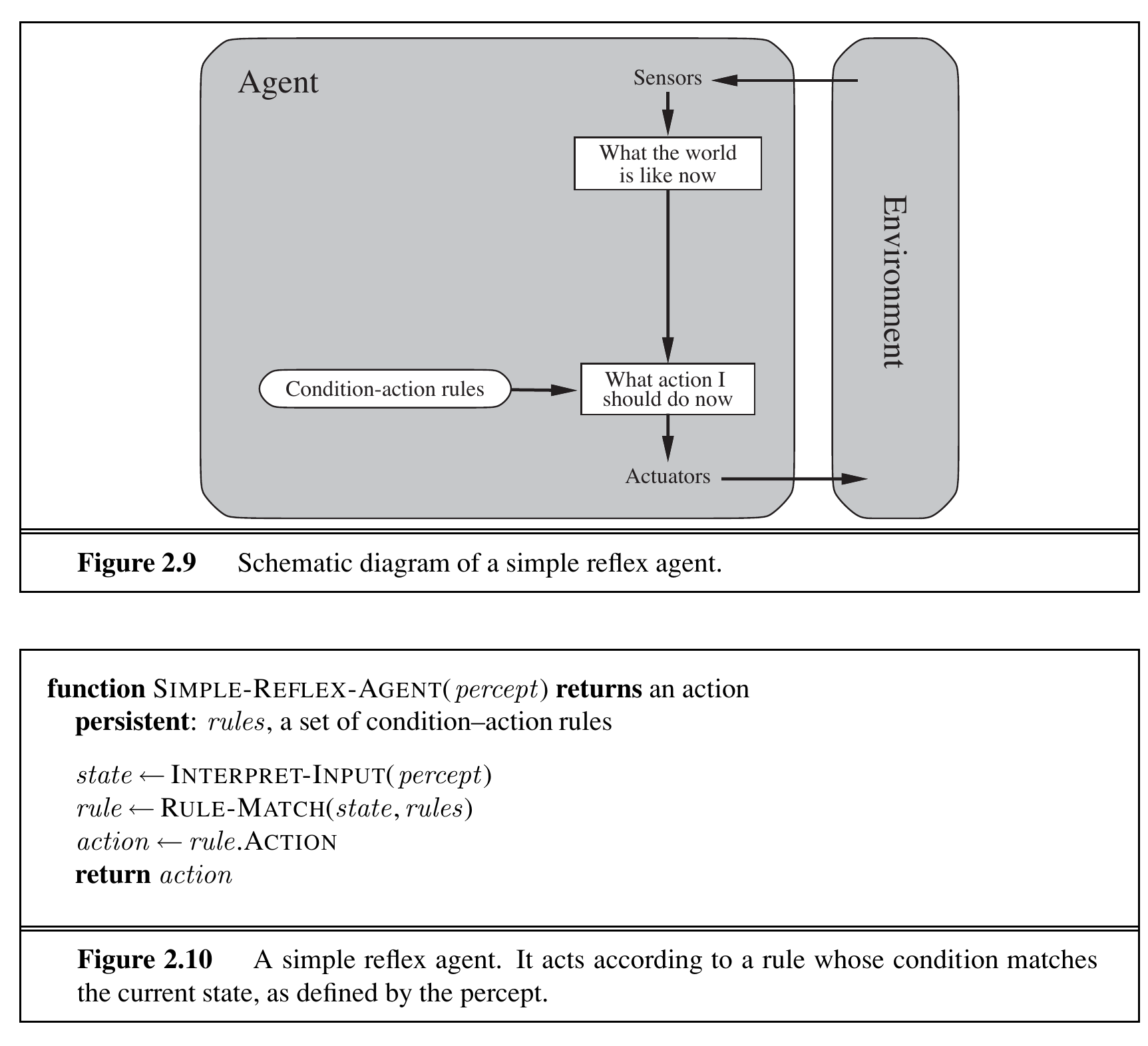
A simple reflex agent selects actions based solely on the current percept, ignoring the rest of the percept history. It uses condition–action rules (if–then rules) to map percepts directly to actions.
1
2
3
4
5
6
	function SIMPLE-REFLEX-AGENT(percept) returns an action
	persistent: rules, a set of condition--action rules
	state <- INTERPRET-INPUT(percept)
	rule <- RULE-MATCH(state, rules)
	action <- rule.ACTION
	return action
Simple Reflex Vacuum Agent
The vacuum agent program:
1
2
3
4
5
		function REFLEX-VACUUM-AGENT([location, status]) returns an action
		if status = Dirty then return Suck
		else if location = A then return Right
		else if location = B then return Left
This program implements the agent function from the vacuum world table in Section [sec:agents-environments]. It ignores percept history, reducing the table from $4^T$ entries to just $4$ rules.
Simple reflex agents are limited: they work only if the environment is fully observable. Even a little unobservability can cause infinite loops. Escape is possible through randomization, but more sophisticated agents handle this better.
Model-Based Reflex Agents
Model-Based Reflex Agent
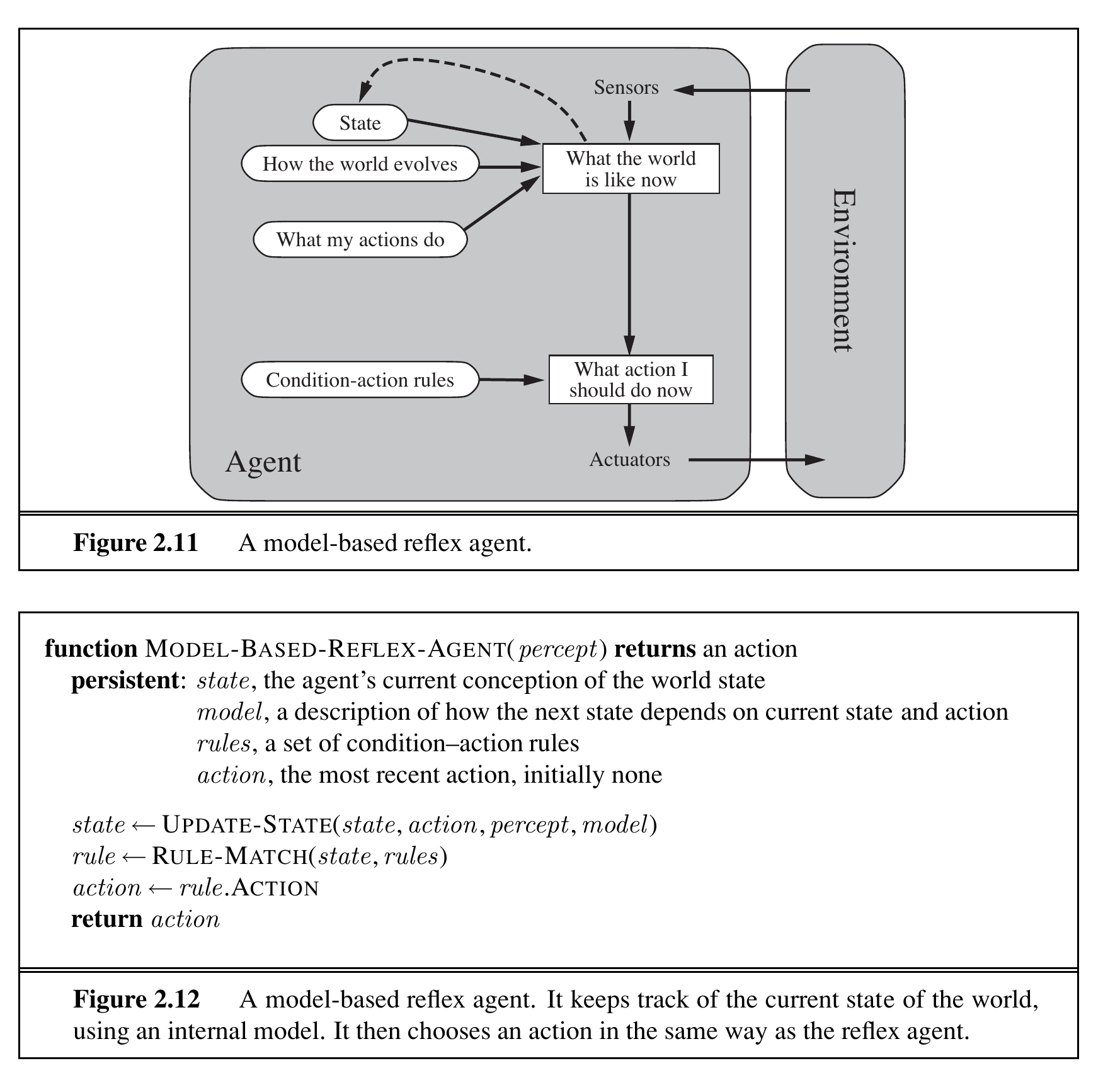
A model-based reflex agent maintains internal state that depends on the percept history, allowing it to handle partial observability. It uses a model of the world – knowledge about how the world evolves independently of the agent and how the agent’s own actions affect the world.
1
2
3
4
5
6
7
8
9
	function MODEL-BASED-REFLEX-AGENT(percept) returns an action
	persistent: state, the agent's current conception of the world
	model, description of how next state depends on current state and action
	rules, a set of condition--action rules
	action, the most recent action, initially none
	state <- UPDATE-STATE(state, action, percept, model)
	rule <- RULE-MATCH(state, rules)
	action <- rule.ACTION
	return action
Model-Based Taxi Agent
A taxi driver uses internal state to track vehicles that are temporarily out of sight. The car in front’s brake lights may be ambiguous in a single frame, but comparing the current and previous frames reveals which lights are brake lights versus turn signals. The model encodes knowledge like “an overtaking car generally gets closer behind over time.”
Goal-Based Agents
Goal-Based Agent
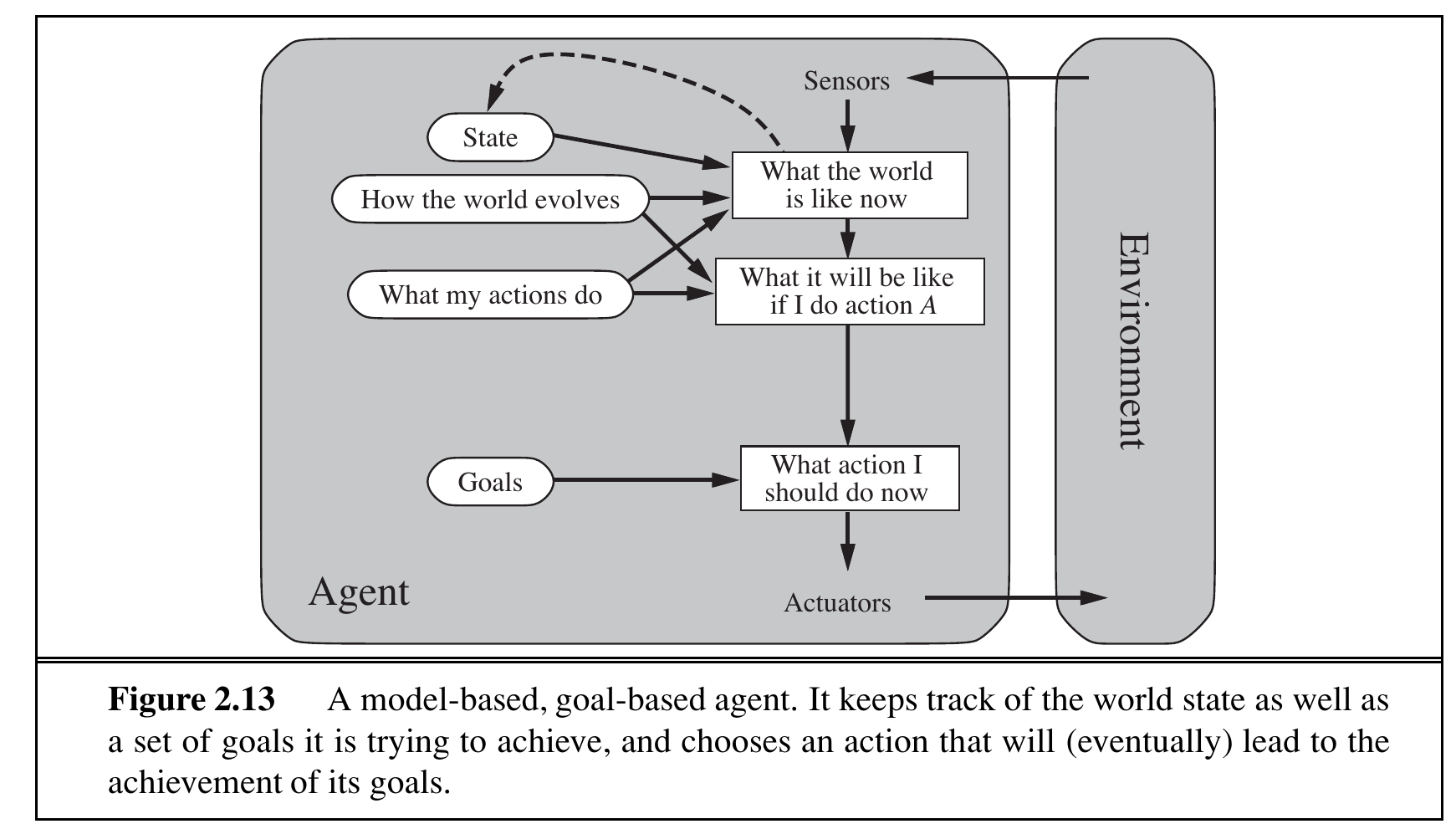
A goal-based agent combines a model of the world with goal information that describes desirable situations. It chooses actions that achieve the goal, often by searching through sequences of actions.
1
2
3
4
5
6
7
8
9
	function GOAL-BASED-AGENT(percept) returns an action
	persistent: state, model, goals
	state <- UPDATE-STATE(state, action, percept, model)
	plan <- SEARCH(state, goals, model)
	if plan is not empty then
	action <- FIRST(plan)
	else
	action <- a default action
	return action
Goal-based agents search through possible action sequences to find one that achieves the goal. This search can be computationally expensive, but it provides enormous flexibility.
Goal-Based Taxi Agent
At a junction, the taxi can turn left, turn right, or go straight. The correct decision depends on the goal destination. The agent uses its model to predict outcomes and searches for an action sequence leading to the goal. Goal-based agents are more flexible than reflex agents: changing the destination requires only updating the goal, not rewriting all rules.
Utility-Based Agents
Utility-Based Agent
A utility-based agent uses a utility function that assigns a numerical measure of happiness to each state. It chooses the action that maximizes expected utility, weighing the likelihood of success against the importance of goals.
The agent selects $a^* = \operatorname{argmax}_a EU(a)$.
Utility Function
The utility function $U(s)$ internalizes the performance measure. If the internal utility and external performance measure agree, then maximizing utility produces rational behavior according to the performance measure.
1
2
3
4
5
6
	function UTILITY-BASED-AGENT(percept) returns an action
	persistent: state, model, utility
	state <- UPDATE-STATE(state, action, percept, model)
	for each action a do
	expected[a] <- SUM_{s'} P(s' | a, state) * U(s')
	return argmax_a expected[a]
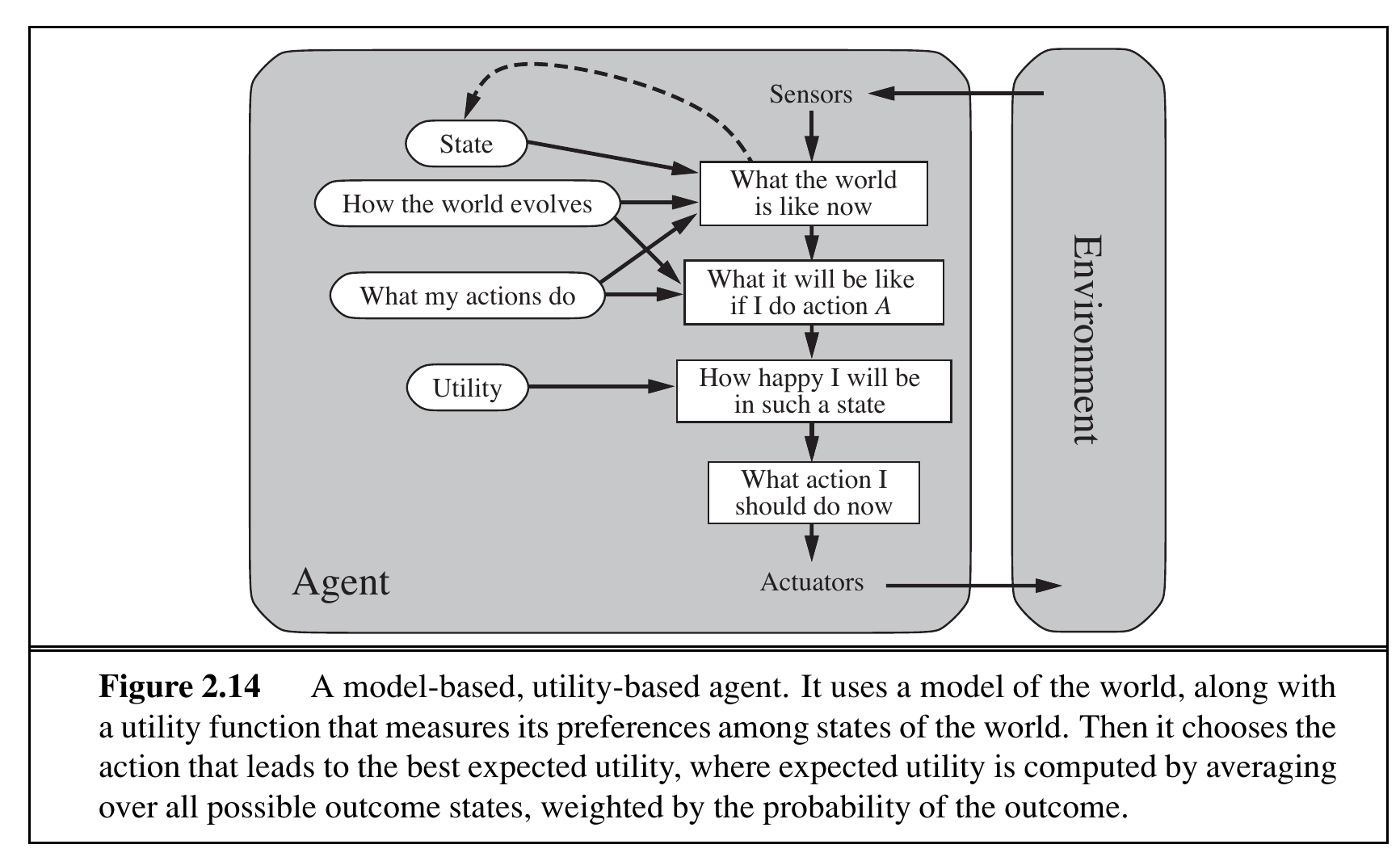
Utility-Based Taxi Agent
Goals provide a binary distinction (happy vs. unhappy), but utility allows comparison. Multiple action sequences reach the destination, but some are quicker, safer, cheaper, or more reliable. When goals conflict (speed vs. safety), utility specifies the appropriate tradeoff. When no goal is achievable with certainty, utility weighs success likelihood against importance.
Learning Agents
Learning Agent
A learning agent improves its performance over time. It has four conceptual components: the learning element (responsible for making improvements), the performance element (selects external actions), the critic (provides feedback on performance), and the problem generator (suggests exploratory actions).
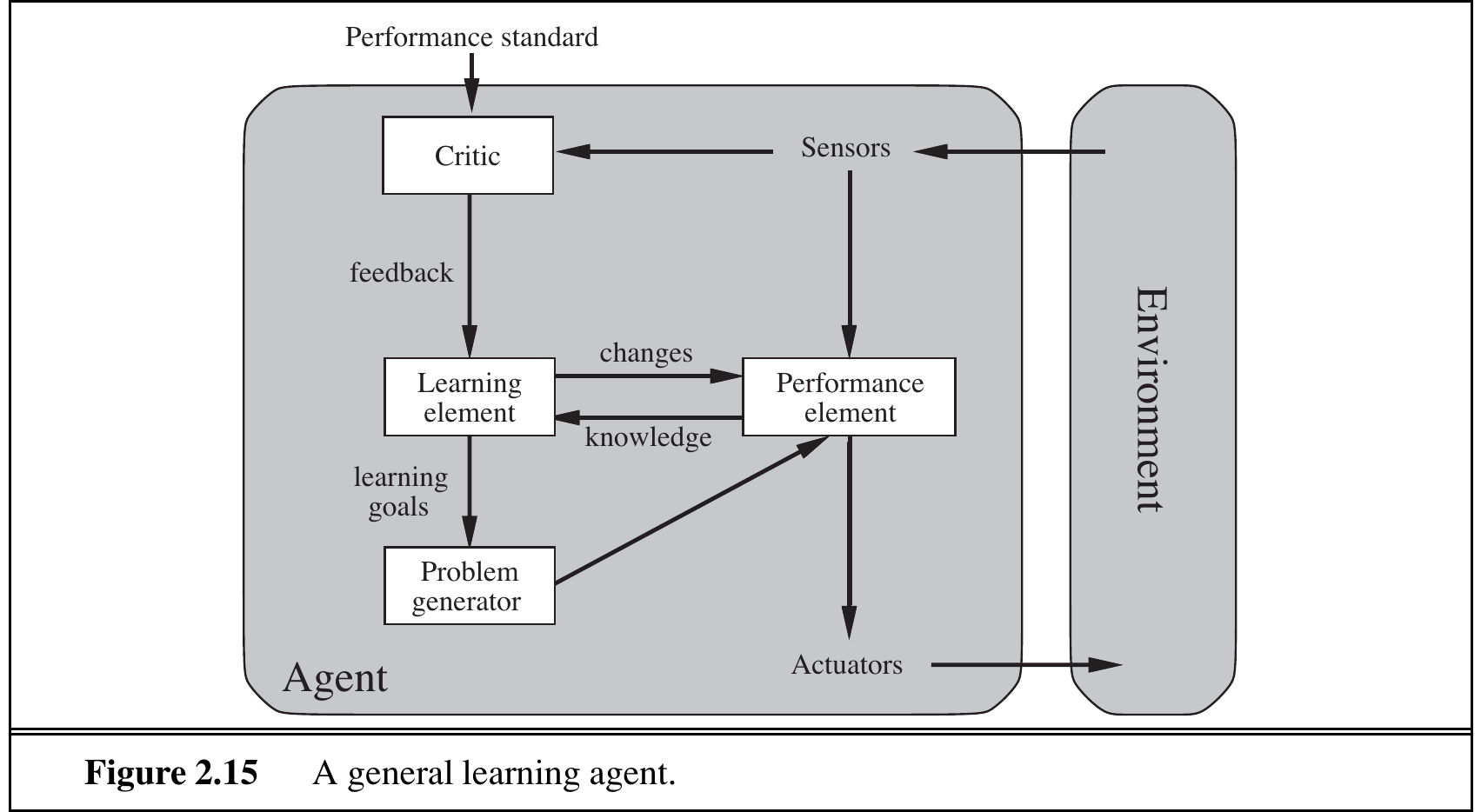
Learning Agent Components
Performance element: the entire decision-making body; takes in percepts and selects actions.
Learning element: uses feedback from the critic to modify the performance element for future improvement.
Critic: evaluates the agent’s performance against a fixed performance standard (external to the agent).
Problem generator: suggests exploratory actions that may be suboptimal short-term but discover better long-term strategies.
Learning Taxi Agent
The taxi drives using its performance element. After a sharp left turn across three lanes, the critic observes the other drivers’ reactions. The learning element formulates a rule: this was a bad action. The problem generator might suggest testing brakes on different road surfaces. Over time, the agent learns how the world evolves and what its actions do, improving overall performance.
Knowledge Representation Concepts
Three Levels of Representation
Agent components can represent the environment along an axis of increasing complexity and expressive power: atomic, factored, and structured representations.
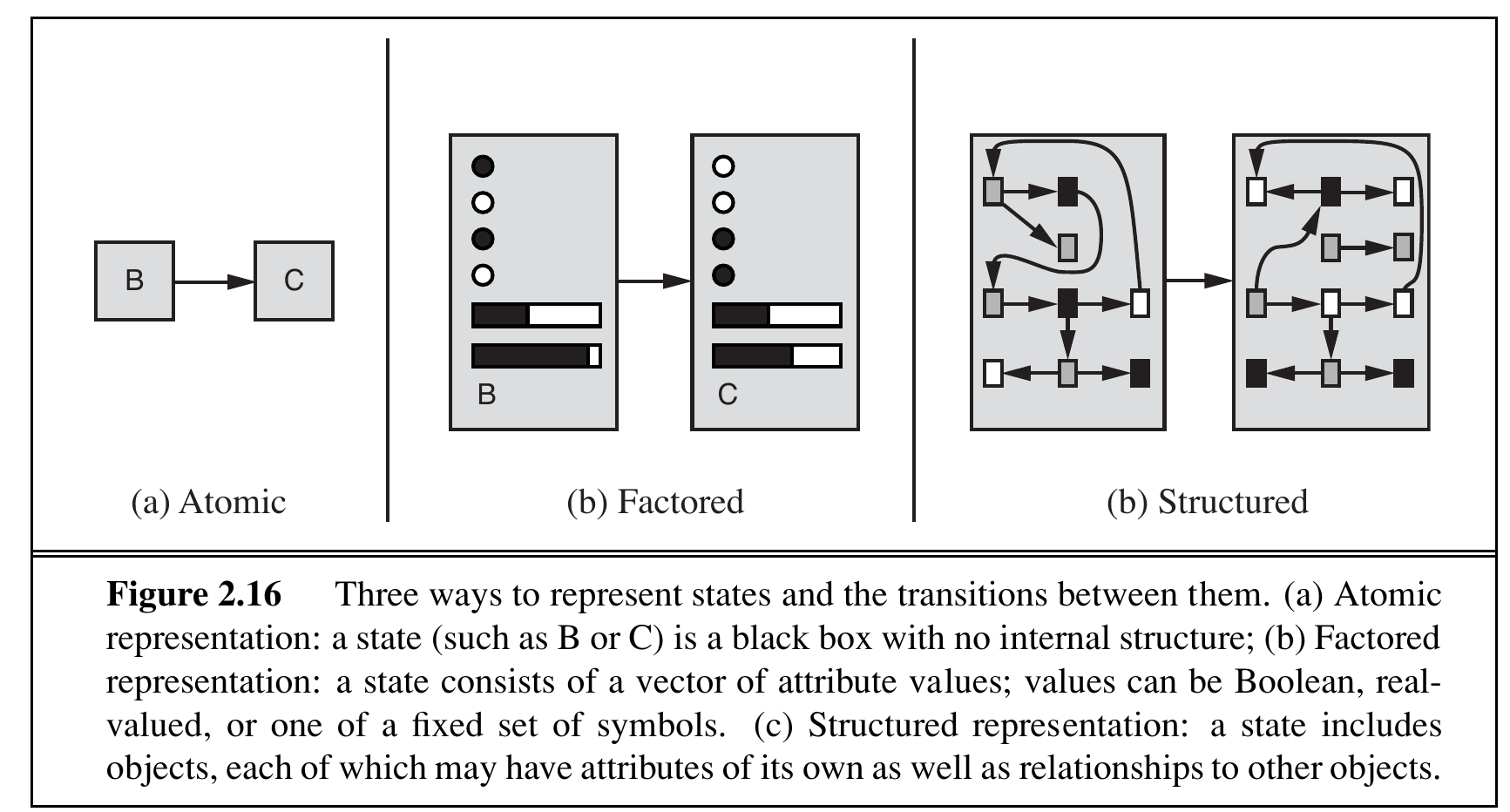
Atomic Representation
In an atomic representation, each state of the world is indivisible – it has no internal structure. The state is a black box whose only discernible property is being identical to or different from another state. Search algorithms (Chapters 3–5), HMMs, and MDPs work with atomic representations.
Atomic Representation Example
For the route-finding problem, each state is simply the name of a city (e.g., Arad, Sibiu, Bucharest). The representation treats each city as an indivisible atom. There is no internal structure describing population, weather, or landmarks.
Factored Representation
A factored representation splits each state into a fixed set of variables or attributes, each of which can have a value. Different states can share attribute values, making it easier to work out how to transform one state into another. Factored representations also support representing uncertainty (blank attributes).
Factored Representation Example
A taxi’s state might include variables: location (GPS coordinates), fuel level (0–100), oil warning light (on/off), speed (mph), and radio station. Two states can share the same location but differ in fuel level. CSPs, propositional logic, planning, and Bayesian networks use factored representations.
Structured Representation
A structured representation describes objects and their relationships explicitly. It can capture complex scenarios involving multiple objects with varying attributes and relationships, which would be impractical in a factored representation.
Structured Representation Example
“A large truck ahead is reversing into a dairy farm driveway, but a loose cow is blocking the truck’s path.” This scenario involves objects (truck, cow, driveway) with relationships (blocking, reversing into). Encoding this in a factored representation would require an impractical number of specific attributes. First-order logic, relational databases, and natural language understanding use structured representations.
More expressive representations are more concise but make reasoning and learning more complex. Real-world intelligent systems may need to operate at all points along this axis simultaneously.